
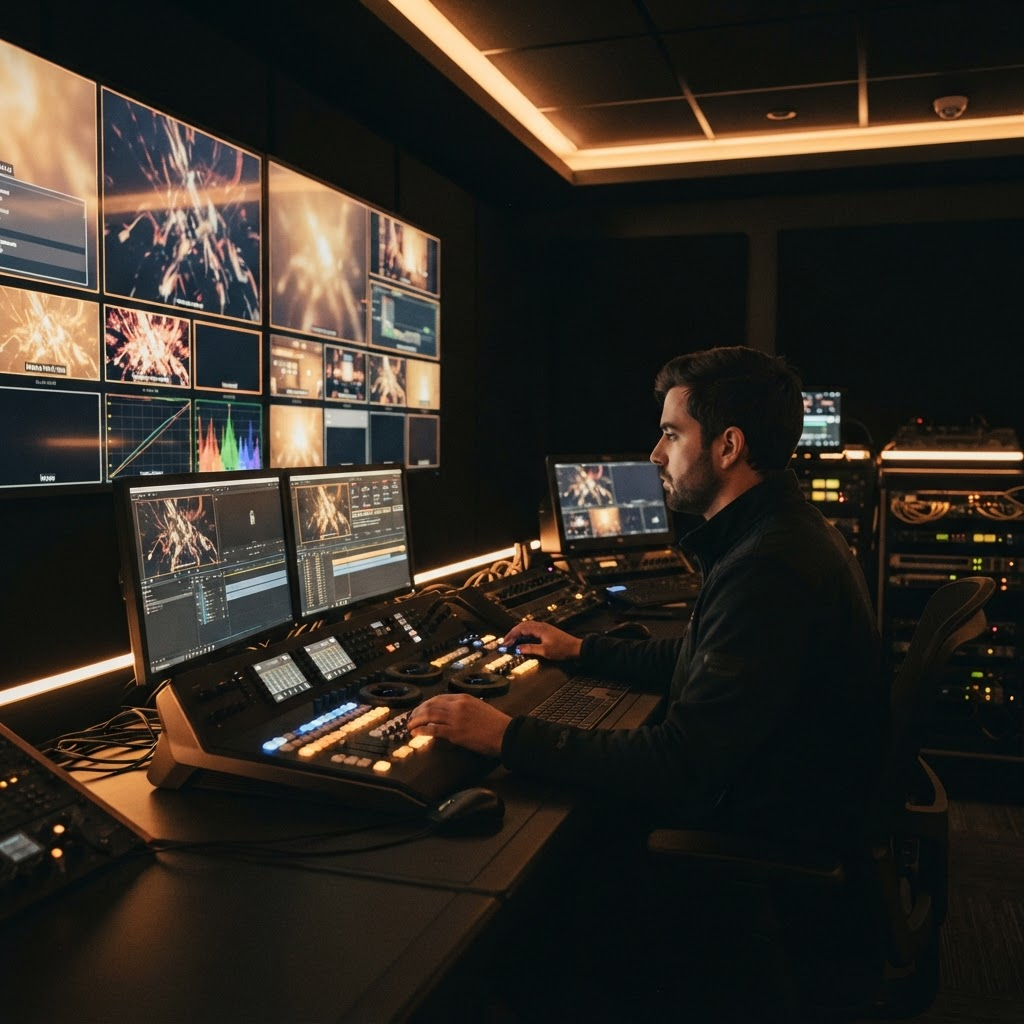
Generative models are very good at producing a lot of nearly-right material very quickly. They are not good at signing off a brand campaign. The suite is built around that split: models do the drafting, our artists do the deciding and the finishing.
The result is a pipeline that removes the slow, repetitive middle of production — the fourth round of boards, the eighth variation of a background plate — while the frames that actually ship still pass through a person who knows what the client agreed to.
What the suite does
- Drafts shots. Generates look options, backgrounds and key frames from a written brief and reference, so a direction can be judged on screen instead of described in a meeting.
- Boards fast. Turns a script into storyboards and animatics in hours, with consistent characters and locations across every panel.
- Moves it. Produces motion tests and shot-length clips from approved frames — camera moves, transitions and effects passes.
- Hands off to artists. Everything arrives in the editing and compositing tools the team already uses, as layers and sequences, not as a finished mystery.
Why it is built this way
The failure mode of generative production is not quality, it is drift. A character's jacket changes between panels. A logo grows a letter. A background city is subtly the wrong city. Left alone, a model will happily produce forty beautiful frames that do not belong to the same film.
So the pipeline is designed around consistency and review, not around raw generation:
- Look, characters and key assets are locked before shot work starts, and every later stage references those locks.
- Nothing reaches a client without an artist pass — cleanup, grade, comp and timing.
- Every version is kept, so a decision can be walked back without regenerating from scratch.
The pipeline, stage by stage
1. Brief and look development
The starting point is the same as any production: what is this for, who is it for, what does it need to feel like.
- Reference is gathered and turned into a set of style frames — a handful of images that define the palette, lens, texture and mood.
- The client approves a look here, on stills, before anything expensive begins.
2. Locking the assets
Characters, products, environments and brand marks are established as reusable references so they hold their identity across every later shot.
- Product and logo geometry is treated as fixed, not as something a model may reinterpret.
- Where a likeness or a real product is involved, we work from supplied assets rather than generated approximations.
3. Boards and animatic
The script becomes panels, then a timed animatic with scratch audio.
- Boards carry the locked characters and locations, so the client is reviewing the actual film, not a sketch of a different one.
- Timing problems surface here, where they cost hours instead of days.
4. Shot generation and motion
Approved frames become moving shots.
- Image-to-video for camera moves and performance; generated elements for skies, crowds, particles and set extensions.
- Multiple takes per shot are normal — the point is to give the director options, not to accept the first result.
5. The artist pass
This is where the work becomes deliverable, and it is not optional.
- Cleanup and roto, stabilisation, upscaling to delivery resolution.
- Compositing generated elements onto plates, grading for a single consistent look across the cut.
- Sound, titles and the final assembly in the studio's normal edit tooling.
6. Delivery and versions
- Masters and platform cut-downs — the same film in the aspect ratios and durations each channel actually needs.
- Project files, layers and prompt records handed over, so a later revision does not start from nothing.
What it changes
The saving is in the drafting, not the craft. Look development that took a week of illustration becomes an afternoon of options. Boards that took days come back the same day. Background plates and set extensions stop being a scheduling problem.
The finishing time barely moves — and that is the point. The frames that carry the brand still get the same attention they always did.
Where we are careful
- Rights and provenance. We agree up front which models and which reference material are acceptable for the work, and keep a record of what produced what.
- Likeness and real products. Real people and real products come from supplied assets, not from a model's guess at them.
- Disclosure. If a client needs to state how a piece was made, the pipeline can produce that trail.
What we build
We set the look, lock the assets, run the generation, and put our artists on the end of it. You review on frames and cuts, the way you always have — just sooner, and more often.